

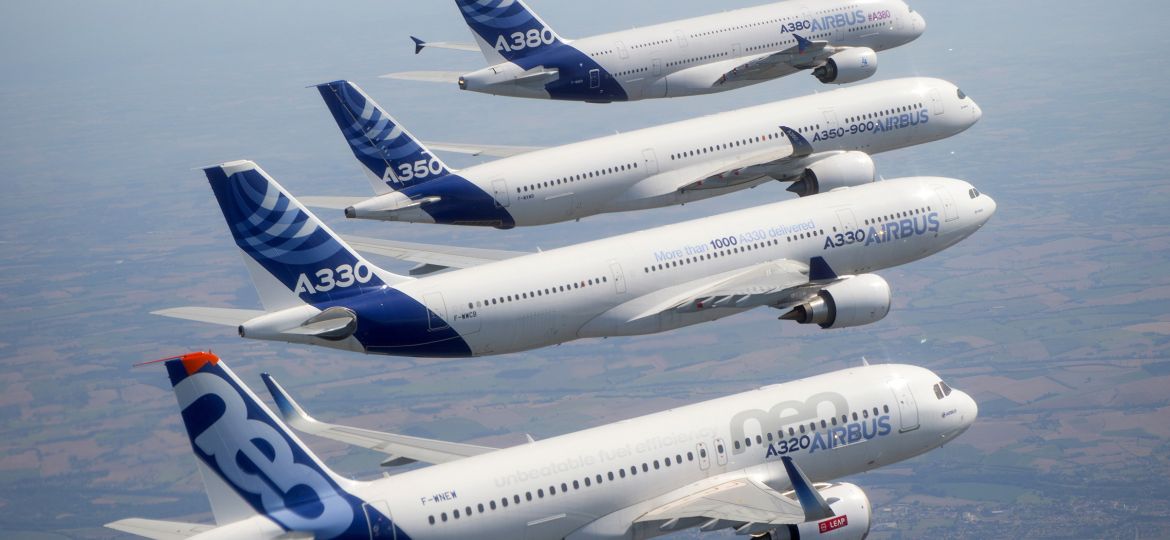
Airbus is the world’s most valuable aerospace and defense brand and the leading Original Equipment Manufacturer (OEM) in commercial aviation. Having surpassed its main rival Boeing in both delivery volumes and total in-service fleet size, it currently serves as the premier global manufacturer of passenger and freighter aircraft.
Airbus consistently leads the market, having reported over 260 deliveries globally in the early months of the year, outperforming competitors in the narrowbody sector. The company holds a historic backlog of over 8,700 aircraft, ensuring more than a decade of guaranteed production. Brand Value: Airbus is recognized as the top aerospace and defense brand globally, valued at USD 27.2 billion.
Despite short term uncertainties, in the long-term, passenger traffic will grow by 3.6% annually, driven by global GDP (+2.5%), urban populations (+1.2 billion) and an increase of 1.5 billion in the global middle class who represent the demographic most likely to fly. This growth requires a need for around 43,400 new passenger and freighter aircraft deliveries over the next 20 years. Some 34,250 will be typically single aisle and 9,170 will be typically widebodies. Around 44% of these new deliveries (18,930) will replace less fuel-efficient previous generation models.
A key benefit of aviation is to connect people and enable commerce, even in times of uncertainties, not only domestically but further afield. This is leading to some emerging flows and evolving markets. Overall, domestic India traffic growth (+8.9%) is the world’s highest, followed by emerging Asia to China (+8.5%) and Middle East with emerging Asia (5.3%). These evolving markets and new city pairings are being served by Airbus’ full range of aircraft. As these routes grow in passenger volume, the size of aircraft will follow. This upsizing is a clear Airbus advantage where commonality between the A320, A330 and A350 families means airlines can operate mixed single aisle and widebody fleet using crews with multi type ratings.
A doubling in the global in-service fleet above 49,000 aircraft by 2044 will generate a need for new pilots, technicians, cabin crews and create careers throughout the aviation eco-system. Huge opportunities will exist in aircraft maintenance and efficient operations as part of the sector’s sustainability drive. Airbus Customer Services is well positioned to offer state of the art solutions for this as well as in predictive maintenance to optimize availability and avoid flight disruptions as well as reducing fuel needs. End to end supply chain management, as spare parts availability is a key focus, and the growing availability of USM (Used Serviceable Material) are offering cost-effective solutions to improve fleet availability. Customer Services is also well positioned to provide connectivity on aircraft to boost operational efficiency and passenger experience, as well as improving the recyclability of aircraft.
Dominates the narrowbody and widebody markets via the A220, A320neo, A330neo, and A350 families. The A320neo family remains the fastest-selling airliner.
Holds nearly a 40% market share in the civil and parapublic helicopter sector, and builds civil and military variants globally.
Defence and Space: Acts as a prime contractor for military transport (e.g., C295), secure satellite communication programs, and fighter jet consortiums.
Airbus operates Final Assembly Lines (FALs) across the globe, diversifying risk and regional dependence:
Primary headquarters and massive assembly operations in France, Germany, Spain, and the UK. Significant operations in Mobile, Alabama (A320 & A220 FAL), and Canada. Engineering and customer support hubs in Singapore and expanding facilities in India (including the C295 program in Vadodara and the H125 assembly line in partnership with Tata Group).Industry
To maintain its pole position, Airbus is heavily focused on transitioning to Industry 4.0 smart factories and advancing sustainable aerospace, such as exploring hydrogen propulsion technologies. It has also vertically integrated further by acquiring and fully consolidating aerostructures suppliers like Spirit AeroSystems and Premium AEROTEC.
As of May 31st, 2026, Airbus reported its total commercial aircraft backlog at 9,247 aircraft, representing a net increase of 276 units from the end of April as the substantial influx of new orders during the month comfortably outpaced deliveries. This extensive order book remains heavily weighted toward the single-aisle market, which now accounts for 7,493 outstanding commitments for the A320neo family alongside 592 orders for the smaller A220 program. The widebody portfolio continues to sustain long-term depth with 1,162 twin-aisle aircraft on order, a total that includes 877 firm commitments for the A350 and 285 for the A330. When evaluated against the manufacturer’s current 2026 delivery target of approximately 870 aircraft, this backlog secures roughly 10.6 years of production coverage for the manufacturer.
Vincent Fernandes
