

The Munich Airport Group once again reported a net profit after taxes of €169 million in 2025. Compared to the previous year, this represents a significant increase of 105 million euros. Driven by growth in passenger numbers and flight movements, revenue reached a new record of nearly 1.8 billion euros. Operating profit before interest and taxes improved significantly as well, amounting to 219 million euros, up from 195 million euros the previous year.
The increase in annual revenue can be attributed to the strong traffic growth at Munich Airport in 2025. A total of 43.4 million passengers traveled through the Bavarian aviation hub. Compared to the previous year, this represents an increase of 1.8 million passengers, corresponding to passenger growth of 4.4%. The number of flight movements also saw positive growth, with more than 337,000 takeoffs and landings, which is 3.1% higher than the previous year.
The main driving forces behind this growth were once again European and intercontinental traffic. Traffic to European destinations and the Mediterranean region rose by around four percent. Long-haul traffic showed particularly strong performance, increasing by approximately nine percent compared to 2024.
Munich Airport’s route network expanded further in 2025. Most recently, it included 232 destinations worldwide. A total of 96 airlines, including five freighter carriers, operate regular flights to the airport. The positive trend in the cargo sector continued. Air cargo volume increased by 10 percent, reaching approximately 340,000 tons and surpassing pre-crisis levels by 2 percent.
Traditional costumes, festival beer and live music bring Oktoberfest spirit to Munich Airport
When Munich’s famous call of “O’zapft is!” – the beer is tapped – marks the beginning of Oktoberfest season, the festive spirit can also be experienced at Munich Airport.
Visitors and travelers can enjoy a genuine Oktoberfest atmosphere with traditional costume pop-ups, the Airbräu Oktoberfest celebration, Bavarian brass bands, and other special attractions. As a welcoming gesture, the airport also distributes traditional gingerbread hearts to guests.
The celebrations at the airport begin even before the first festival tent officially opens in downtown Munich, bringing Bavarian hospitality and Oktoberfest flair to travelers from around the globe as well as visitors from the region.
“Every day, people from all over the world come together at Munich Airport. During Oktoberfest in particular, our guests can experience the warmth, tradition and hospitality Bavaria is known for, right here at the airport.
The fact that so many brands are joining in the celebration and bringing a taste of Oktoberfest to the airport makes this time particularly special for us,” says Maria Dahlhaus, Senior Vice President of Commercial Activities at Munich Airport.
Whether before departure, after arrival, or during a visit to the airport, guests can shop, celebrate, and immerse themselves in Bavarian culture in both the public areas and the passenger-only zones beyond security.
Munich Airport welcomes its one billionth passenger
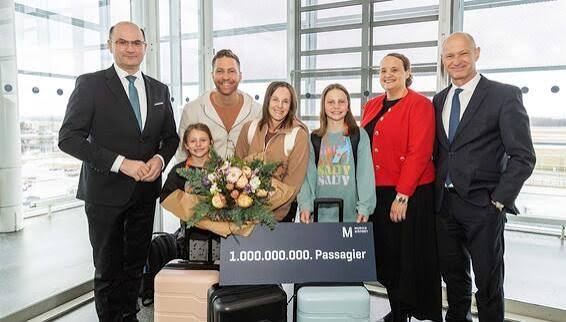
Munich Airport reached a special milestone in passenger numbers today: At noon, the airport welcomed its one-billionth passenger since it opened in 1992. The airport celebrated this symbolic moment together with its partner, Lufthansa. This significant milestone marks Munich Airport’s transition into one of Europe’s leading aviation hubs, serving approximately 100 airlines and offering global connections.
The one-billionth passenger was Amanda Walls, who was traveling with her family and was welcomed directly at the gate in Terminal 2 of Munich Airport by Albert Füracker, Chairman of the Supervisory Board of Munich Airport; Jost Lammers, CEO of Munich Airport; and Roswitha Becker, Vice President of Operations at Lufthansa Airlines in Munich. To mark this special occasion, the family received vouchers for visits to the Lufthansa Senator Lounge and the airport brewery Airbräu, as well as a voucher for airport parking.
Minister of State Albert Füracker emphasized the significance of this milestone: “One billion passengers represent over three decades of successful regional development in Bavaria. Munich Airport is a central pillar of infrastructure in the Free State and Bavaria’s important ‘gateway to the world.’ Through its partnership with Lufthansa, the airport has developed into a major European aviation hub and a five-star airport. Today’s milestone underscores the airport’s performance and its importance to our state’s economy, tourism, and employment. My thanks go to everyone who works tirelessly every day to make this possible.”
Munich Airport CEO Jost Lammers said: “The one-billionth passenger is, above all, a sign of appreciation for the work of our employees. They have guided Munich Airport through many years of growth and challenging times, bringing the vision of a premium hub to life. This moment also serves as an incentive to continue developing Munich Airport in a quality-oriented and sustainable manner.” The close partnership with Lufthansa was also a key factor in the airport’s success. Roswitha Becker, Vice President of Operations at Lufthansa Airlines, added: “We are delighted to fly Mrs. Walls to Munich, Bavaria’s premier hub, as the airport’s one-billionth guest. The successful collaboration between FMG, the Free State of Bavaria, and Lufthansa is unique and special. It forms the foundation of this airport’s remarkable history. We will continue to work closely and collaboratively to enhance the airport’s appeal to passengers from around the world.”
The airport’s journey to its one-billionth passenger began on May 17, 1992, when flight operations commenced at its current location in northeast of Munich. Unlike the original plan to open the new airport with two Lufthansa planes landing simultaneously, the first aircraft to touch down that morning was a charter flight from Aero Lloyd. The McDonnell Douglas MD-83 arrived from Izmir, Turkey, and thus went down in history as the first aircraft to actually land with passengers at the new Munich Airport.
The arrival of the first passengers marked the beginning of the airport’s transformation into an international aviation hub. Shortly after Germany’s reunification and the end of Europe’s decades-long division, Munich Airport was able to fully capitalize on its central location in the heart of the continent. What started as a new international airport has evolved into a premium hub with global connections. Today, it plays a central role in passenger mobility, Bavaria’s economy, and international air traffic.
Today, Munich Airport is one of Europe’s most important aviation hubs, connecting Bavaria with over 230 destinations in more than 70 countries. Thanks to its commitment to quality, its operational efficiency, and its international focus, the airport has established itself as a major player in global aviation. Munich Airport recorded significant traffic growth in 2025. A total of 43.4 million passengers traveled through the Bavarian aviation hub. The number of flight movements also showed a positive trend, with approximately 337,000 takeoffs and landings – three percent higher than the previous year. The average seat load factor reached 80.9%, confirming the high demand for air travel. Last year, air cargo volume surged by ten percent to 340,000 tons, surpassing pre-crisis levels by two percent.
A group with suitcases at the airport is holding a sign for the billionth passenger and a bouquet of flowers
Right at the gate, Albert Füracker, Chairman of the Supervisory Board of Munich Airport (far left), Roswitha Becker, Vice President of Operations for Lufthansa Airlines in Munich (second from right), and Jost Lammers, CEO of Munich Airport (far right), welcomed Amanda Walls (center) and her family.
